Custom Enterprise Management Systems for Real Business Workflows
Some businesses buy packaged ERP or CRM software and then discover that their teams must change their workflows to fit it. Separate tools remain in use, data stays fragmented and accurate decision-making reports are difficult to produce.

Some businesses buy packaged ERP or CRM software and then discover that their teams must change their workflows to fit it. Separate tools remain in use, data stays fragmented and accurate decision-making reports are difficult to produce.
A custom enterprise management system addresses this by supporting the company's actual operating model. This guide explains what it is, when to invest and how to assess an implementation partner.
Custom Enterprise Management Systems for Real Business Workflows
What Is a Custom Enterprise Management System?
It is software developed around analysis of a company's real management processes. Modules, data flows and interfaces are designed for those processes rather than inherited from a packaged ERP or CRM product.
Characteristics of a Truly Custom System
Modules match business workflows, ownership of data and the delivered system is clearly agreed, and the architecture supports additional modules as the company grows.
How It Differs from Customizing an Existing ERP or CRM
Adding fields to an existing product stays within the provider's platform. A custom system designs the architecture and data-processing logic around the company's management requirements.

Limitations of packaged business management software
When Should a Business Build Its Own System?
Consider a custom system when specialized processes are not adequately supported or when fragmented data needs to be brought together.
Industry-specific operations, such as made-to-order manufacturing or mixed-service business models.
Sales, logistics and finance need one shared platform to prevent duplication and inconsistent information.
Excel files, accounting software and customer-service tools make consolidated reporting difficult.
Continuous growth requires new modules without replacing the entire foundation.
For simple and common workflows, packaged software can still provide lower costs and faster implementation.
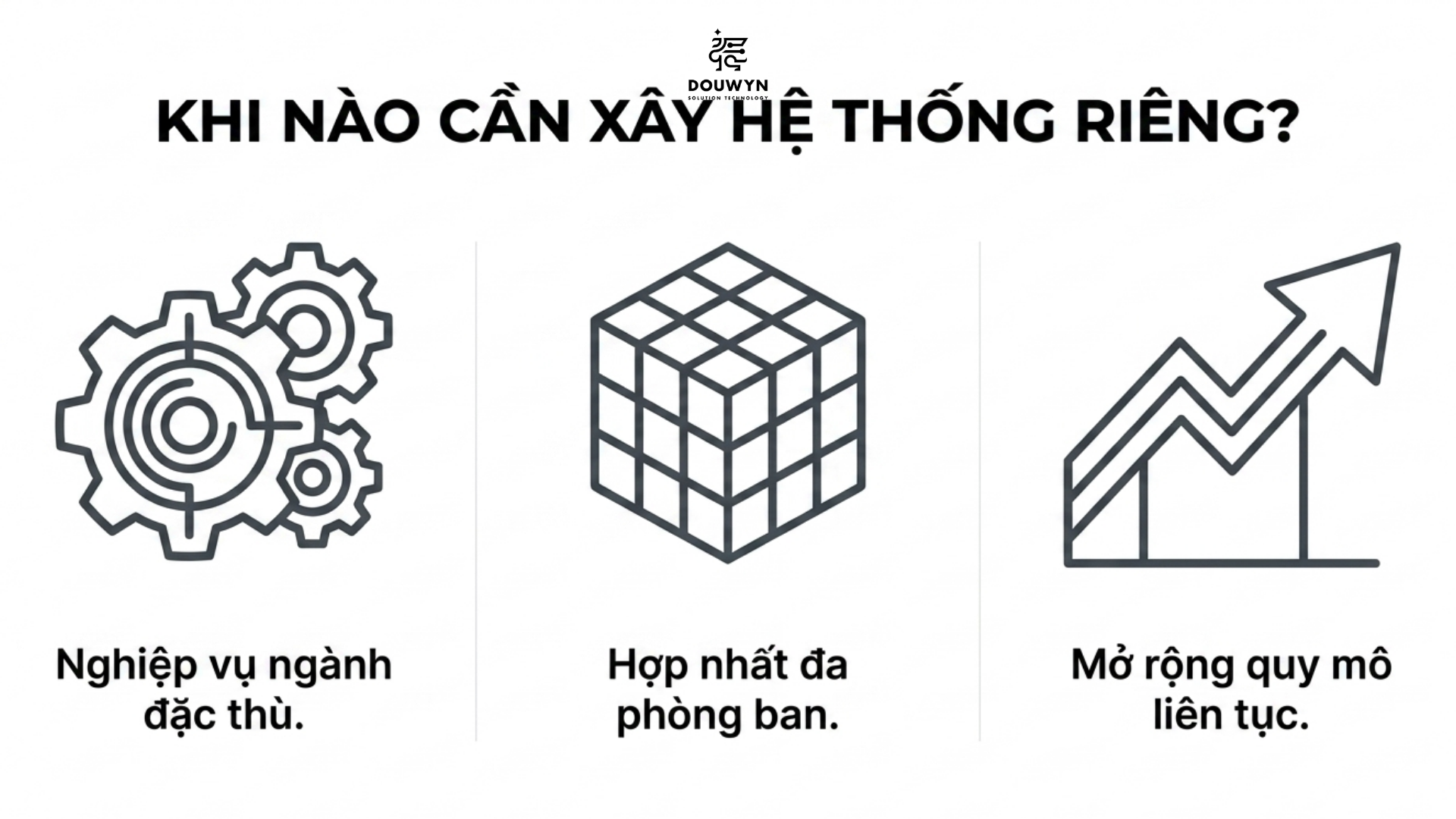
When a business needs a purpose-built management system
Custom Systems Versus Packaged ERP and CRM
The core differences are workflow fit and system control.
Packaged systems may require workflow changes; custom systems follow agreed management processes.
Packaged products generally have lower subscription-based entry costs; custom systems require greater initial investment.
Subscriptions can grow with users and modules; custom systems still need infrastructure and maintenance, but costs can be planned around actual requirements.
Packaged expansion depends on the service plan; custom systems can add tailored modules.
Data ownership, access and system handover should be stated clearly in the agreement.
Advantages of a Purpose-Built System
Unified management processes give the business a more complete view for decisions. New departments and workflows can be incorporated into the same architecture.
When Packaged Software Is More Suitable
Small or newly established businesses with common processes can start with packaged software and revisit custom development when scale or complexity increases.

Comparing Douwyn custom management systems with packaged software
Common Modules
Customer and Sales Management: CRM
Track customer information, transaction history and sales progress according to the industry's actual workflow instead of generic sales stages.
Resources and Operations: ERP
Manage resources, inventory, production or services according to the business model. Complex manufacturing and supply processes often benefit from tailored modules.
Human Resources and API Integration
HRM can support employee records, attendance and payroll policies. APIs connect external services such as payment gateways or electronic invoicing. Douwyn also provides API integration and workflow automation services.
Technology for Sustainable Management Systems
The foundation should support stable processing and future modules.
Headless architecture separates processing from presentation, supporting additional interfaces and platforms. Cloudflare infrastructure contributes to reliability and protection against unusual traffic, which matters when customer and financial data is involved. CI/CD practices help test and deploy new modules efficiently while reducing disruption.
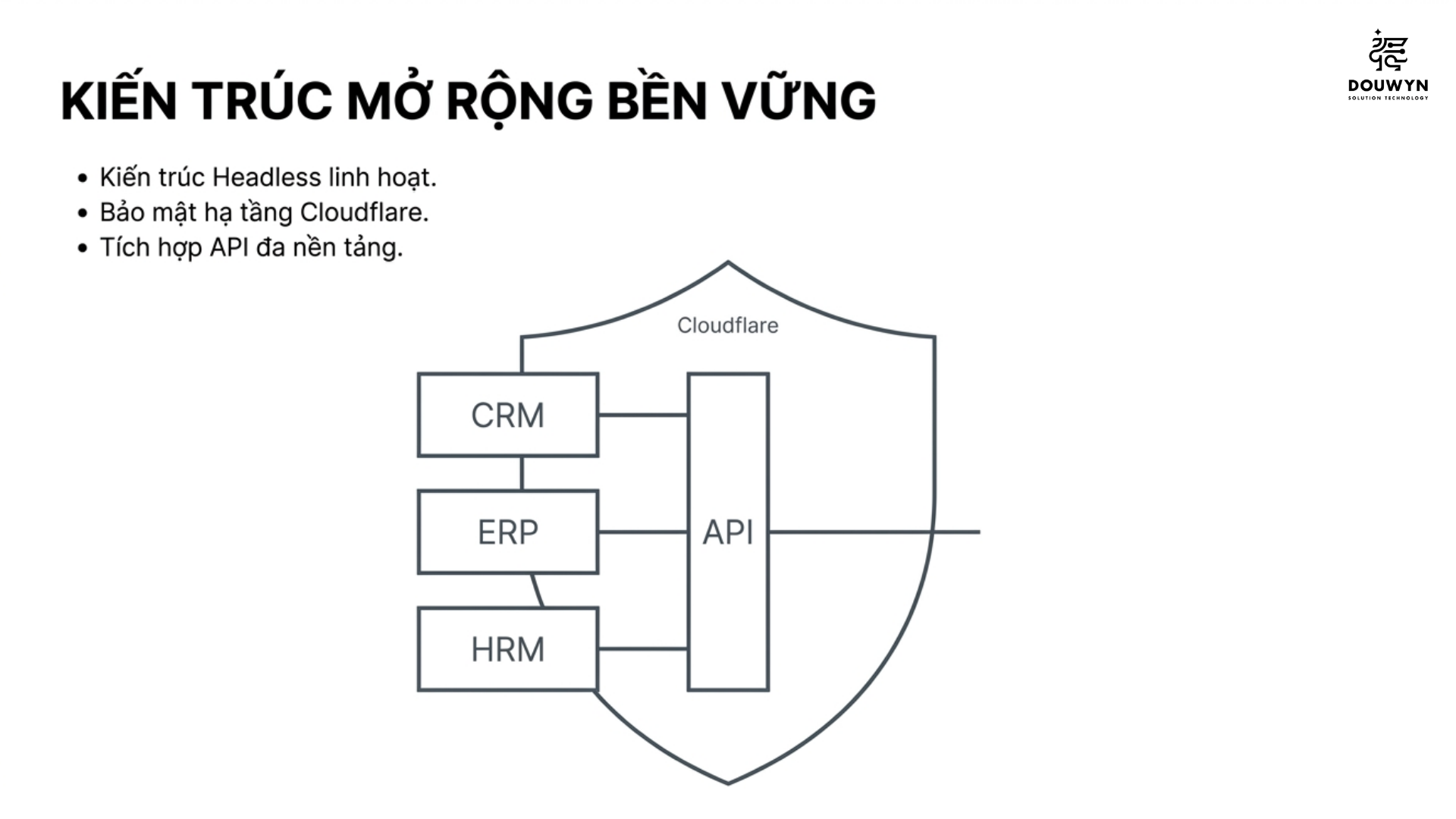
Headless software architecture and Cloudflare protection
Douwyn's Six-Step Delivery Process
Steps 1–2: Process Discovery and Departmental Analysis
The team studies sales, logistics, finance and other relevant departments to understand existing processes and improvement needs. This guides the system architecture.
Steps 3–4: Architecture and Module Development
The agreed scope is divided into CRM, ERP, HRM or other modules. Development and testing can proceed in parallel while preserving room for expansion.
Steps 5–6: Testing, Training, Handover and Support
The system is tested with realistic data. Department-specific training helps internal staff use the new system confidently, and operational support continues during the initial launch period.
What Determines the Cost?
Key factors are module count, number of users, third-party integration and reporting or permission requirements.
A basic customer-management module costs less than a combined CRM, ERP and HRM platform. Detailed role permissions add implementation work. Accounting and payment integrations increase costs according to the complexity of each connection.
Implementation Risks to Avoid
Incomplete process discovery can omit important management steps and cause repeated rework.
Missing staff training makes transition difficult and reduces the value of the investment.
Unclear source-code and data handover terms can undermine long-term control.
No module-expansion roadmap may force a rebuild when major features are needed.
Why Choose Douwyn?
Douwyn offers a defined process and clear commitments throughout delivery.
Project-specific architecture uses headless technology and Cloudflare for performance, protection and expansion.
CI/CD practices support efficient module updates with reduced interruption risks.
Flexible API integration connects existing accounting tools, payment gateways and other systems.
Source code and technical documentation are handed over as agreed.
Continued collaboration supports additional modules as the company grows.

Douwyn's development team and CI/CD workflow
Frequently Asked Questions
How does a custom system differ from packaged ERP? It follows the company's management processes instead of requiring teams to fit a provider's standard features.
Does every small or medium business need one? No. Simple workflows can start with existing software; specialized systems become more useful as complexity grows.
How long does implementation take? Depending on modules and integrations, it commonly takes weeks to months.
Can modules be added after launch? Yes, when flexible expansion is planned in the architecture.
Will less technical staff struggle? Department-specific training and a gradual transition help teams become familiar with the new system.
Conclusion
A custom management system suits businesses whose specialized processes cannot be fully supported by packaged software. Unified data, workflow fit and flexible expansion can justify the higher initial investment and reduce reliance on disconnected tools.
Douwyn can study your management processes and propose a solution aligned with your budget. Contact Douwyn for a detailed quotation.
Related articles
All posts
What Is an SEO-Friendly Business Website, and Which Criteria Should It Meet?
Many businesses invest considerable money in an attractive website but still receive no customers through Google after several months. The interface may be polished while the technical foundation is poorly optimized, making it difficult for search en
Continue reading
Professional Business Website Design: SEO and Cost Optimization
A practical guide to professional business websites: quality criteria, platform choices, delivery steps, budgets and common mistakes.
Continue reading
Enterprise Software Development: A Guide from Strategy to Deployment
As Vietnamese businesses grow, many discover that packaged management software no longer meets their needs. Data is scattered, operations must adapt to the tool instead of the tool supporting operations, and teams spend time on repetitive work that c
Continue reading