Custom Business Software Development That Matches Real Operations
Many businesses buy management software but still need Excel files and manual processes to cover missing features. This wastes time, fragments data and makes it harder to monitor business performance.

Many businesses buy management software but still need Excel files and manual processes to cover missing features. This wastes time, fragments data and makes it harder to monitor business performance.
Custom development offers another approach: build the system around the way the company actually operates. This guide explains the concept, when to invest and how to evaluate a reliable development partner.
Custom Business Software Development That Matches Real Operations
What Is Custom Software Development?
Custom software is built around analysis of a company's specific business processes. Its features, data flows and interface are designed for those operations rather than selected from a packaged product.
Characteristics of Truly Custom Software
Three important characteristics are a close match to business workflows, agreed ownership of data and source code after handover, and the ability to add modules as the company grows.
Customization Versus Building a New System
Changing screens or adding fields in an existing product is limited by that provider's platform. Custom development designs the architecture and processing logic around the company's requirements.

Douwyn's tailored software solution for business operations
When Should a Business Invest?
Consider custom development when specialized workflows cannot be adequately supported by packaged software or when greater control of the system and data is needed.
Industry-specific processes would require substantial changes to an existing product.
Sales, accounting and logistics systems need to share one coherent data flow.
Large data volumes require tailored performance optimization.
The business wants more control over pricing dependencies and future features.
For basic, widely shared management needs, packaged software can still save money and implementation time.
Custom Software Versus SaaS
The main differences concern workflow fit and control.
Workflow fit: SaaS may require operational changes; custom software follows agreed business processes.
Initial cost: SaaS often has lower monthly or annual entry costs; custom development requires a larger initial project investment.
Long-term costs: SaaS charges may rise with users or upgraded features; custom systems still require infrastructure and maintenance but can offer a more predictable cost structure.
Expansion: SaaS is limited by the service plan; custom systems can add purpose-built modules.
Ownership: data access and source-code handover should be specified clearly in the custom development agreement.
Advantages of Custom Development
The strongest advantage is matching real operations without forcing teams to change their work around the tool. The company can also plan system expansion as its business grows.
When Packaged Software Is More Suitable
New businesses with limited budgets and simple processes can start with packaged software, then consider custom development when their requirements exceed its capabilities.
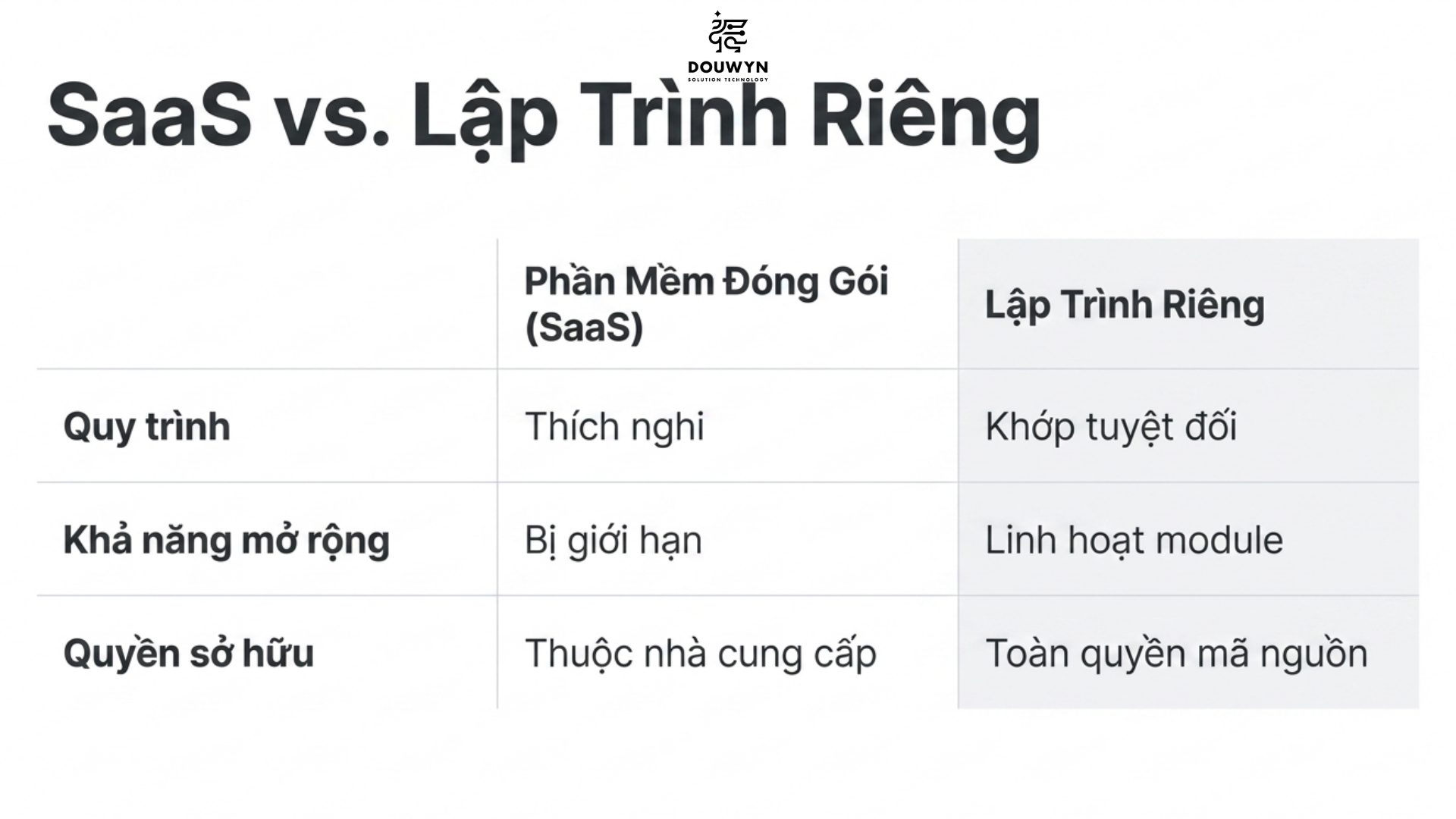
Comparing SaaS and custom software development
Common Types of Custom Business Software
Internal Management: CRM, ERP and HRM
These systems manage customers, resources and employees according to industry-specific workflows. Douwyn develops enterprise management systems for such requirements.
API Integration and Automation
Examples include synchronizing website orders with accounting software and automatically sending notifications when defined events occur. API integration and workflow automation reduce repetitive manual tasks.
Customer and Partner Applications
Order lookup, appointment booking and online contract-management portals often need to reflect each business's particular operating requirements.
Technology for Quality Custom Software
A suitable technology foundation should support stable performance and expansion.
Headless architecture separates data processing from presentation, making new interfaces and integrations easier to develop. Cloudflare infrastructure supports reliable operation during unusual traffic. CI/CD practices help test and deploy updates efficiently while reducing interruption risks.
Douwyn's Development Process
The process includes six steps, grouped into three stages.
Steps 1–2: Business Discovery and Requirements Analysis
The team studies existing workflows, bottlenecks and integration needs. These findings guide the technical architecture.
Steps 3–4: Architecture and Module Development
After scope is agreed, the system is divided into functional modules that can be developed and tested in parallel and expanded later.
Steps 5–6: Testing, Deployment and Operational Support
The system is tested with realistic data before launch. Douwyn supports the initial operational period to address emerging issues promptly.

Douwyn's six-step custom software delivery process
What Determines the Cost?
The main factors are business complexity, module count, third-party integrations and maintenance after handover.
Basic order management requires less work than a system connecting sales, logistics and accounting. Payment gateways and electronic invoicing integrations add development and testing effort. Maintenance should be included in the budget so fixes and updates can continue throughout operation.

Cost factors in Douwyn custom software projects
Risks to Avoid When Selecting a Provider
An unclear testing process can allow failures to appear only when realistic data is used.
Missing source-code handover terms can undermine control if the partnership ends.
Inadequate technical documentation makes future maintenance or transfer harder.
No maintenance commitment leaves responsibility for operational problems unclear.
Why Choose Douwyn?
Douwyn uses a defined process with clear commitments at each project stage.
Project-specific architecture uses headless technology and Cloudflare to support performance and scalability.
CI/CD practices support efficient updates with reduced interruption risks.
Source code and technical documentation are handed over as agreed, supporting long-term independence.
Experience across technology platforms supports security and complex integration needs.
Post-deployment support helps stabilize the initial period of real-world operation.

Why businesses choose Douwyn custom software
Frequently Asked Questions
How long does it take? Depending on complexity and integrations, projects commonly take weeks to months.
How is it different from packaged software? It is developed around the company's workflows, while packaged products may require the company to adapt.
Should small businesses invest? Not always. Simple operations can start with packaged tools and consider custom development when specialized needs arise.
Will the business own the source code? Source-code ownership and handover should be explicitly agreed in the contract before development begins.
Does the system need maintenance? Yes. Monitoring, fixes and updates support stability and future features.
Conclusion
Custom software suits businesses whose specialized processes cannot be fully supported by packaged products. Although initial investment is higher, workflow fit, agreed ownership and flexible expansion can create long-term value.
Douwyn can study your requirements and recommend a solution aligned with your budget. Contact Douwyn for a detailed quotation.
Related articles
All posts
What Is an SEO-Friendly Business Website, and Which Criteria Should It Meet?
Many businesses invest considerable money in an attractive website but still receive no customers through Google after several months. The interface may be polished while the technical foundation is poorly optimized, making it difficult for search en
Continue reading
Professional Business Website Design: SEO and Cost Optimization
A practical guide to professional business websites: quality criteria, platform choices, delivery steps, budgets and common mistakes.
Continue reading
Enterprise Software Development: A Guide from Strategy to Deployment
As Vietnamese businesses grow, many discover that packaged management software no longer meets their needs. Data is scattered, operations must adapt to the tool instead of the tool supporting operations, and teams spend time on repetitive work that c
Continue reading